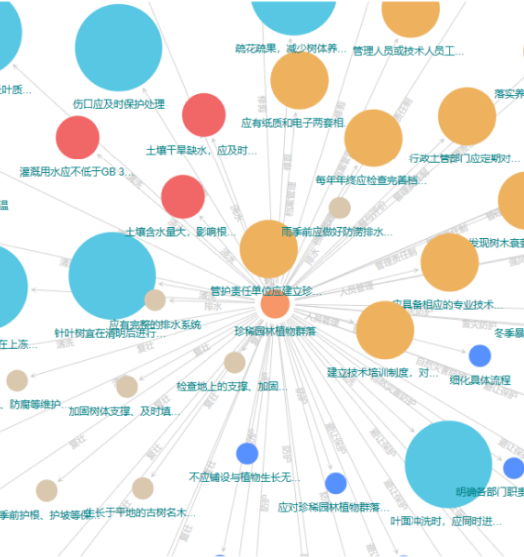
Garden Plant Intelligent Q&A Tool
I. Problems Addressed and Product Positioning
Professionals and enthusiasts in the landscape architecture industry often encounter three main types of difficulties when querying plant knowledge: Firstly, professional materials are scattered. To understand a plant’s family, genus, or maintenance methods, one needs to repeatedly search through resources like the “Flora of China”, local plant configuration lists, and fragmented online content, which is time-consuming and prone to missing key information. Secondly, general-purpose tools have poor adaptability. They either provide vague answers or contain professional inaccuracies. Thirdly, regionalized needs are hard to meet. For instance, frontline personnel inquiring about “plants for rooftop greening in northern China” struggle to quickly obtain solutions tailored to the local climate.
To address these challenges, we have developed a prototype intelligent Q&A tool for landscape plants based on a large language model. It is positioned as a “professional knowledge assistant”, not replacing human judgment but integrating authoritative data on 200 common landscape plants (including classification, cultivation, and pest control) with multi-provincial plant configuration lists. It supports natural language queries and can quickly return accurate answers with cited sources. It is suitable for scenarios such as designers verifying configuration standards, maintenance teams checking technical points, and enthusiasts learning basic care.
II. Practical Value and Effectiveness
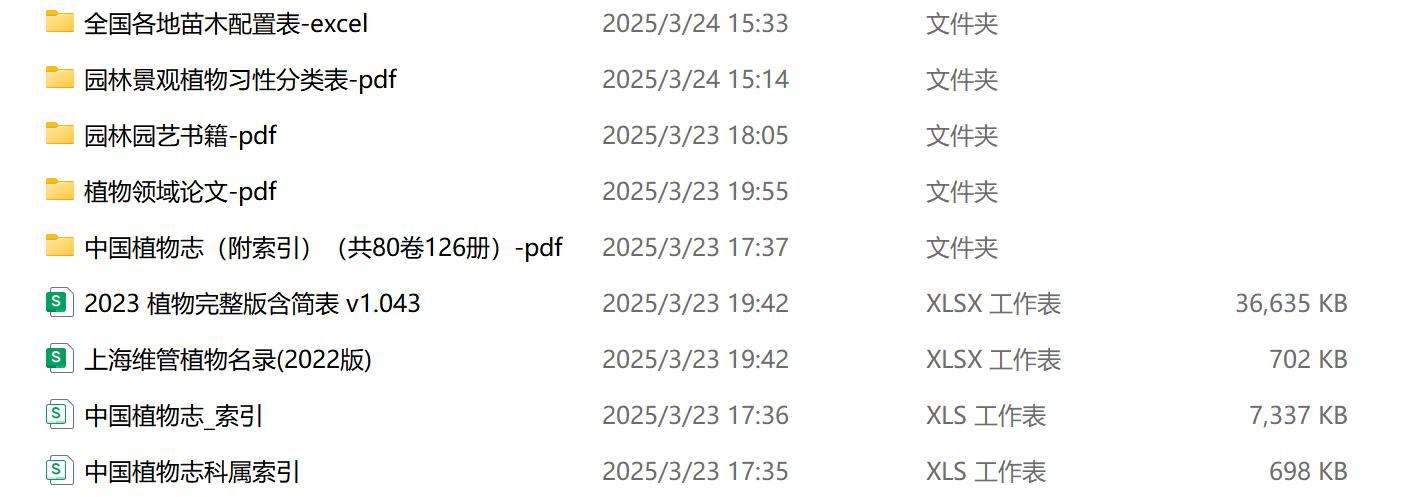
 Figure 1 Data Collection Checklist
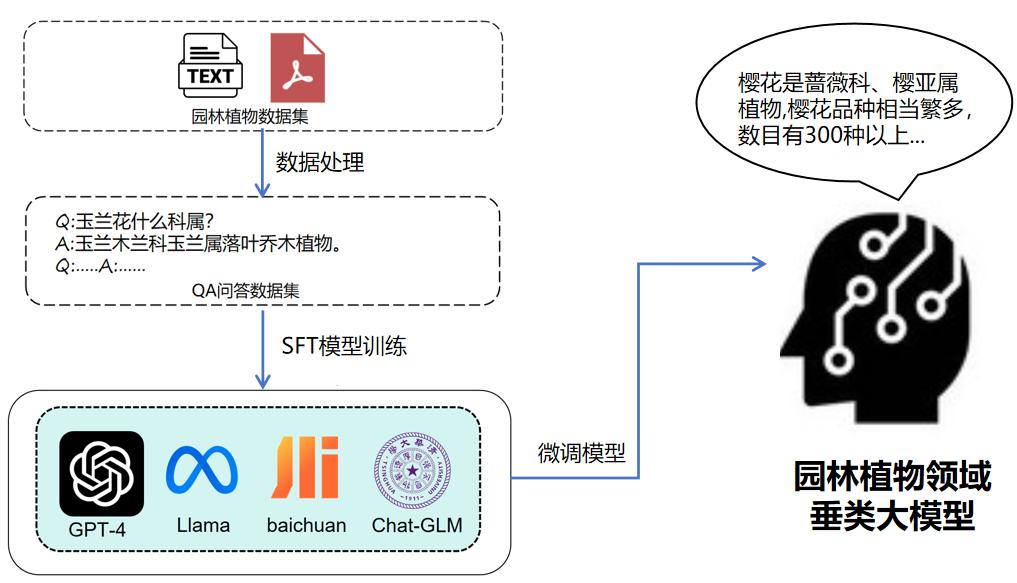 Figure 2 STF Training Example Diagram
Based on testing, the tool can already address core needs: the average accuracy rate for answering professional questions reaches 74.3%, and this increases by a further 4% when combined with retrieval-augmented generation technology. When querying region-specific questions, it can prioritize recommending suitable varieties like Sophora japonica and Pinus bungeana. Compared to manual information searching, efficiency is improved by over 80%. For practical questions like “runing methods for crape myrtle”, it can directly provide specific step-by-step solutions, eliminating the need to piece together information.
 Figure 3 UI Interface Page
Currently, the tool covers most common landscape plants, but there is still room for optimization in areas such as data supplementation for rare species and plant image recognition. If you are a landscape design enterprise seeking to integrate plant knowledge query functionality into your projects, or a landscape software team needing to enrich your product’s professional Q&A module, please feel free to contact us. We can customize dedicated knowledge bases or integrate with existing design software to make the technology better align with practical work needs, facilitating the efficient acquisition and application of landscape plant knowledge.